Panettone
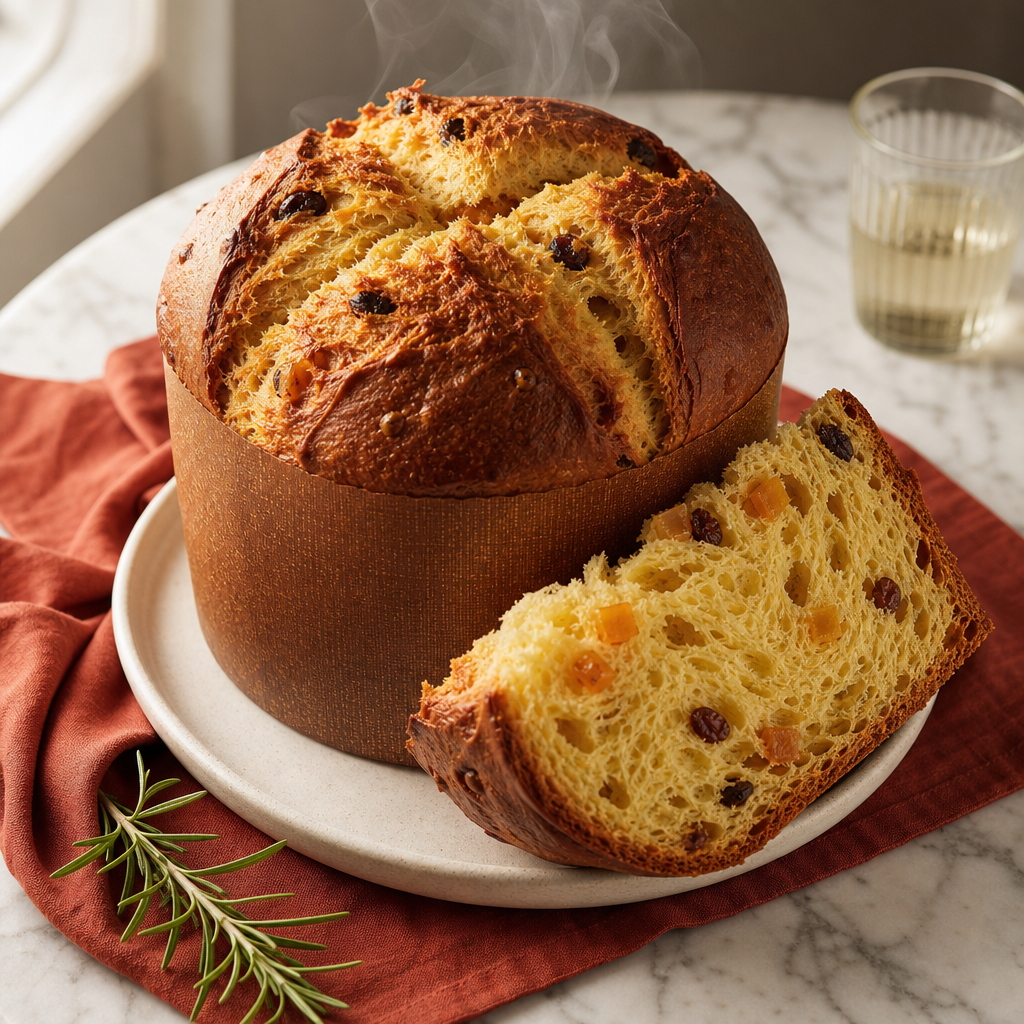
The dish in context
Panettone is the Christmas sweet bread of Milan, now eaten across Italy and exported worldwide in industrial and artisan forms. Older Milanese references describe a rich wheat bread; the modern tall, domed loaf developed with richer doughs, paper collars, and long fermentation. Italian regulations define classic panettone around wheat flour, natural yeast, butter, egg yolks, raisins, and candied citrus. The industrial loaf made panettone global, but the artisan version still depends on the same hard technical point: a strong, low-acid lievito madre that can lift a dough heavy with butter, sugar, and yolks.
Method 17 steps · 4320 min
Strengthen the lievito madre
Refresh the stiff starter three times at 26-28°C before mixing: 1 part starter, 1 part strong flour, 0.45-0.50 part water by weight. Use it when it triples in 3-4 hours, smells milky-yogurty rather than vinegary, and tears in elastic strands.
Soak and dry the raisins
Rinse the raisins under warm water, soak them in rum or warm water for 30 minutes, then drain and spread on a towel until the surface is dry. They should feel plump but not wet.
Make the aromatic paste
Mix the honey, vanilla, orange zest, and lemon zest. Cover and hold at room temperature while the first dough ferments, or refrigerate up to 24 hours.
Mix the first dough
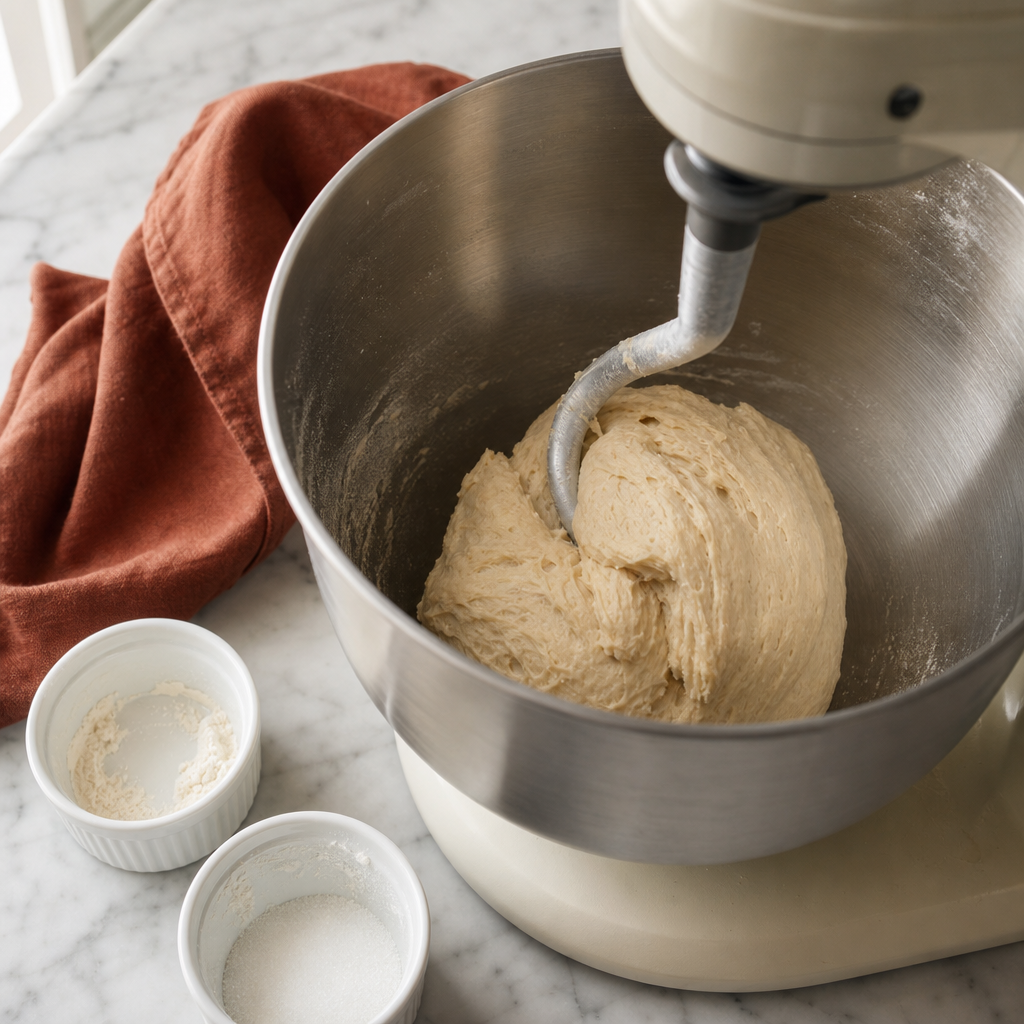
In the mixer bowl, combine 150 g lievito madre, 300 g flour, 120 g water, and 100 g sugar. Mix with the dough hook until the dough gathers and begins to stretch, then add 120 g yolks in 3 additions, mixing back to tension each time.
Add butter to the first dough
Add 120 g butter in small pieces, waiting until each addition disappears before adding the next. Stop when the dough is glossy, pulls from the bowl, and stretches to a thin windowpane; keep final dough temperature at 25-26°C.
Ferment the first dough overnight
Transfer the dough to a straight-sided container and hold at 26-28°C until tripled, 10-14 hours. Do not proceed at double; wait for a true triple with a domed top and visible gas.
Chill briefly if the dough is warm
If the first dough is above 26°C, refrigerate it for 20-30 minutes before the second mix. The dough should be cool enough to accept more yolk and butter without smearing.
Build the second dough
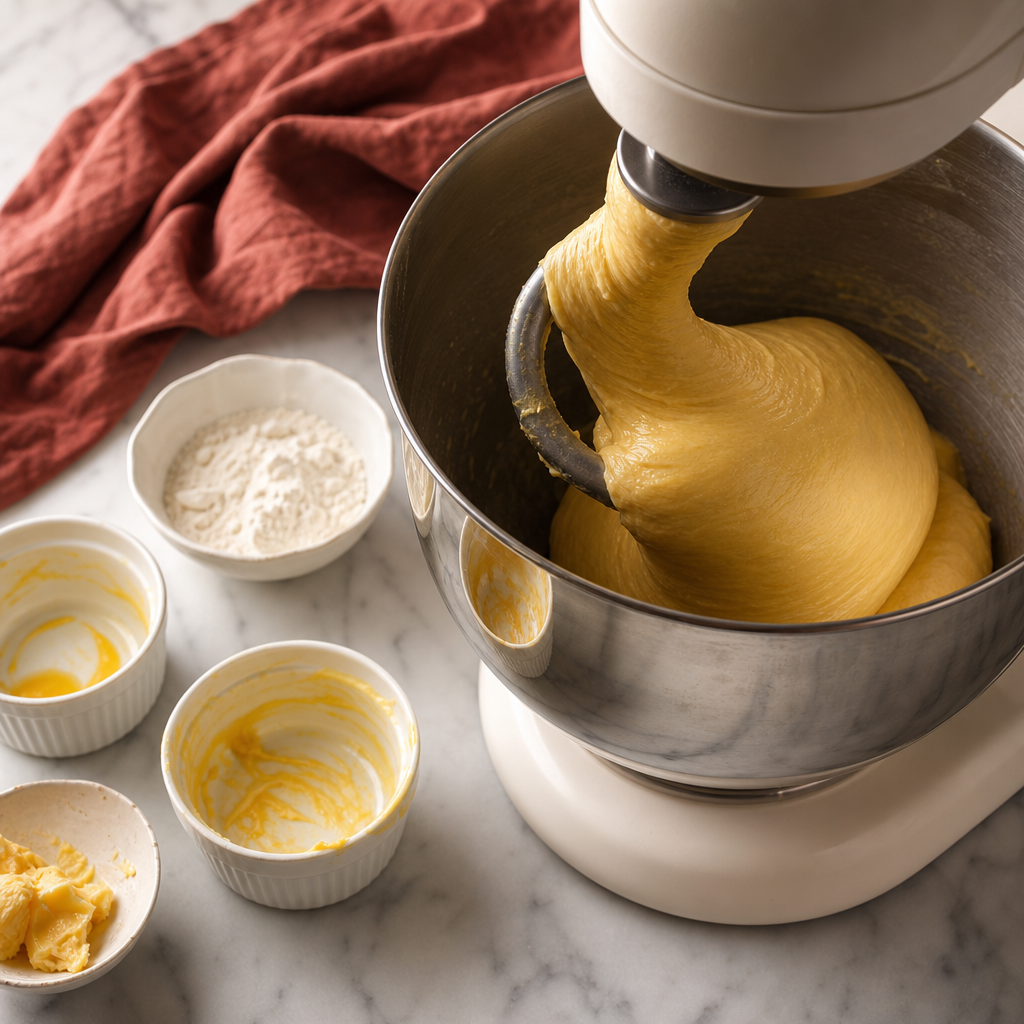
Add the remaining 200 g flour and 3 g malt to the first dough. Mix until tight and elastic, then add 80 g yolks in 2 additions, the remaining 70 g sugar, the aromatic paste, and 8 g salt.
Finish the emulsion
Add the remaining 120 g butter in small pieces. Add up to 50 g remaining water only if the dough is strong, shiny, and wrapping the hook; stop adding water if the dough slackens.
Incorporate the fruit
Mix in the dried raisins, candied orange, and candied citron on low speed for 1-2 minutes, only until evenly distributed. The dough should remain elastic with fruit embedded, not torn into paste.
Rest, divide, and pre-shape
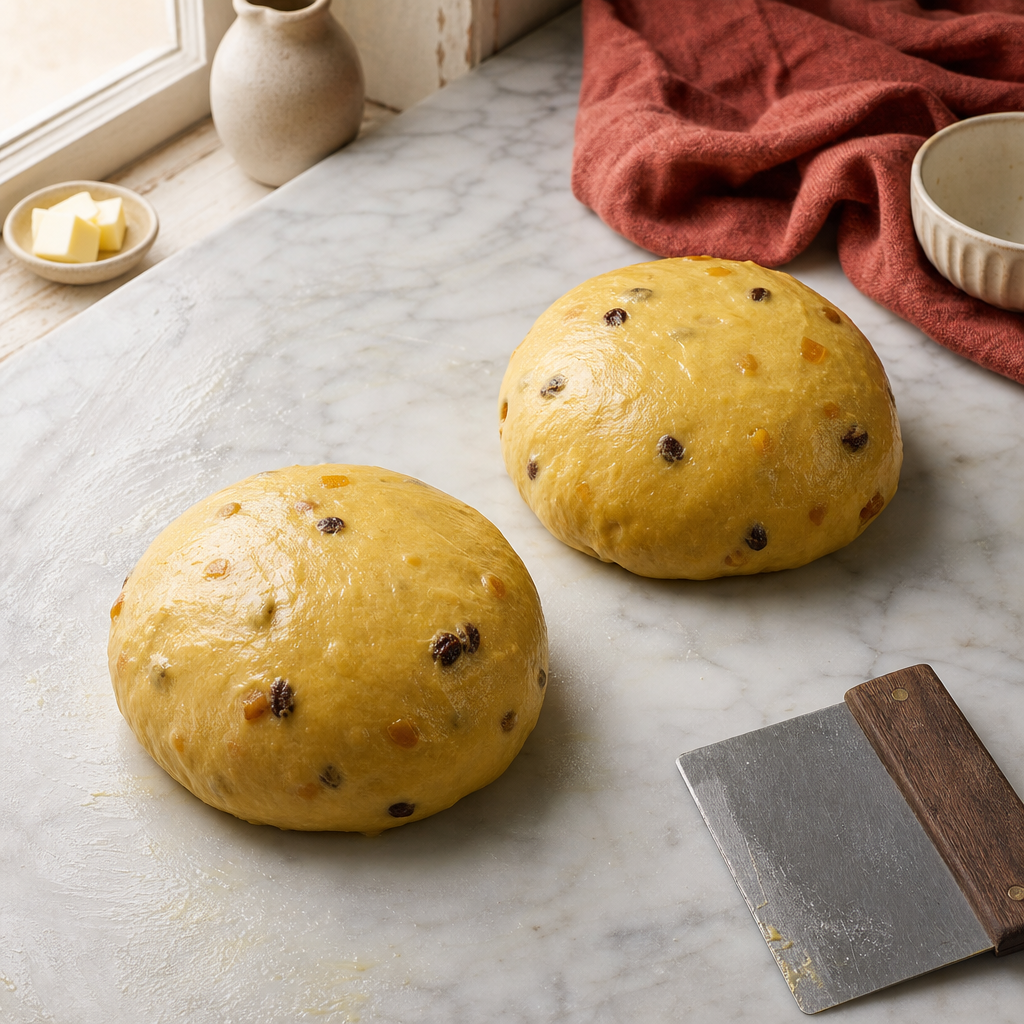
Rest the dough uncovered on a lightly buttered bench for 45 minutes. Divide into two equal pieces, about 900 g each, then round each piece with tight surface tension.
Pirlatura and molding
Rest the rounded pieces 15 minutes, then round again using the pirlatura motion: rotate the dough against the bench so the skin tightens and the base tucks under. Set each piece seam-side down in a 1 kg panettone paper mold.
Final proof
Proof at 28-30°C with humidity until the dough reaches 1-2 cm below the rim, usually 5-7 hours. The surface should look inflated and slightly trembling, not dry or cracked.
Dry, score, and cap
Leave the loaves uncovered at room temperature for 20 minutes to form a thin skin. Score a shallow cross on the top and place a small knob of butter in the center, or peel back the four flaps and return them over the butter.
Bake
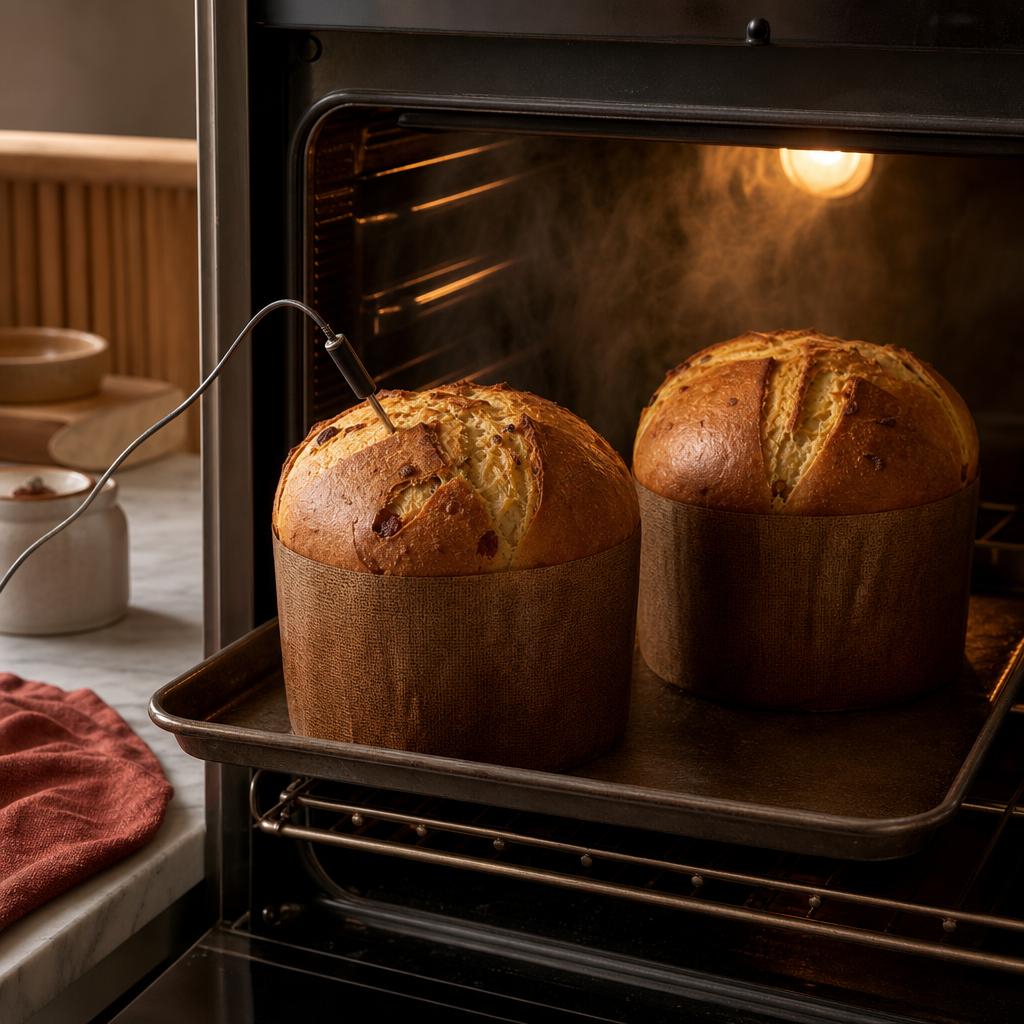
Bake at 170°C in a fully preheated oven until the center reaches 92-94°C, about 45-55 minutes for 1 kg molds. If the dome browns too fast, shield it loosely with foil after the first 30 minutes.
Skewer and invert
Immediately drive two long metal skewers through the base of each mold and hang the loaves upside down between two supports. Cool inverted for at least 8 hours before slicing or bagging.
Mature before serving
Bag the cooled loaves tightly and hold 12-24 hours before cutting. Slice with a serrated knife; the crumb should pull in long yellow strands rather than crumble.
Common mistakes
- {'mistake': 'Using weak flour', 'fix': 'Use strong panettone flour or Manitoba-style flour. Ordinary all-purpose flour cannot carry this enrichment.'}
- {'mistake': 'Mixing with a sour starter', 'fix': 'Refresh the lievito madre until it triples predictably and smells lactic, not sharp. Acid cuts gluten and shortens the loaf.'}
- {'mistake': 'Letting the dough overheat', 'fix': 'Track dough temperature during mixing and stop around 25-26°C. Chill the bowl or ingredients before continuing if it climbs.'}
- {'mistake': 'Adding butter before gluten exists', 'fix': 'Develop the dough first, then add butter gradually. Early fat coats flour and prevents the elastic network from forming.'}
- {'mistake': 'Skipping inversion', 'fix': 'Skewer and hang the loaves the moment they leave the oven. Cooling upright compresses the crumb.'}
- {'mistake': 'Slicing while warm', 'fix': 'Wait until fully cool, then mature in a bag. Warm panettone tears and reads gummy even when baked correctly.'}
What does not belong
- {'item': 'baking powder', 'reason': 'Chemical leavening does not belong in panettone. The structure comes from yeast fermentation and gluten, not cake lift.'}
- {'item': 'oil instead of butter', 'reason': 'Oil removes the dairy aroma and changes the crumb from shreddable to greasy-soft. Butter is structural and cultural here.'}
- {'item': 'whole eggs as a direct yolk replacement', 'reason': 'Whole eggs add water and albumen that change the dough balance. Panettone’s yellow crumb depends on yolks.'}
- {'item': 'cheap mixed peel dust', 'reason': 'Tiny dyed peel bits taste like sugar and bitterness. Classic panettone needs visible candied orange and citron pieces.'}
- {'item': 'nuts in the classic version', 'reason': 'Almonds and hazelnuts belong to variants or glazes. The Milanese classic is raisin and candied citrus.'}
- {'item': 'liquid sourdough straight from the refrigerator', 'reason': 'It brings excess acidity and water. Convert and strengthen it as a stiff starter or bake a different enriched bread.'}