Tortellini in Brodo
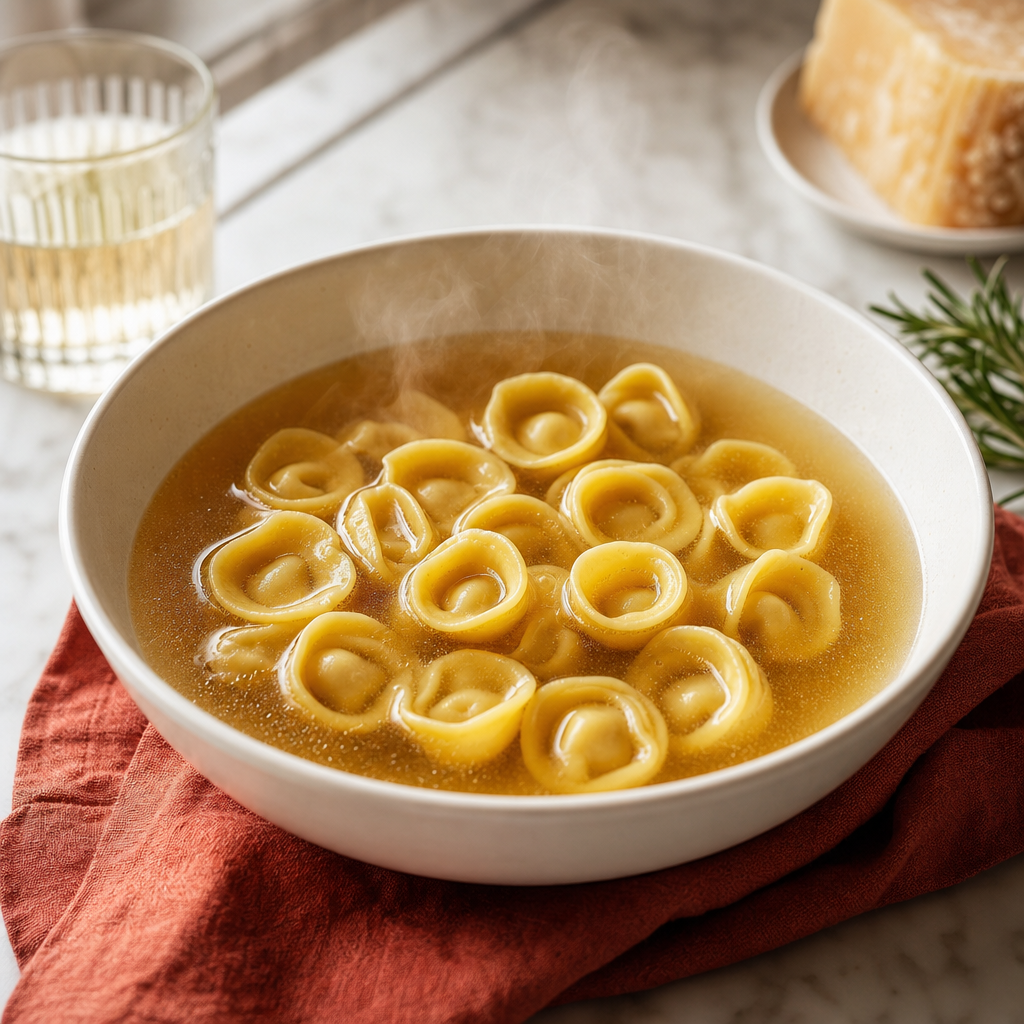
The dish in context
Tortellini in brodo is one of the defining filled-pasta dishes of Emilia-Romagna, claimed most strongly by Bologna and Modena. The canonical filling is meat-forward: pork loin, prosciutto crudo, mortadella Bologna, Parmigiano-Reggiano, egg, and nutmeg, enclosed in thin egg pasta and served in meat broth. The broth is not a backdrop; in the Bolognese table grammar, tortellini are cooked and served in brodo, especially for Christmas and formal winter meals. Larger tortelloni with ricotta and greens are a different pasta, not a larger version of this dish.
Method 10 steps · 420 min
Start the brodo cold
Put the beef, hen or capon, cold water, onion, carrot, celery, and 12 g salt in a stockpot. Bring up slowly over medium heat, stopping before a hard boil. Skim the gray foam as it rises.
Simmer and strain
Hold the broth at a bare simmer for 3 hours, with only an occasional bubble breaking the surface. Strain through a fine sieve, discard the exhausted vegetables, and chill or skim off surface fat. Reduce or dilute to about 2 L, then season until it tastes savory but not salty.
Brown the pork loin
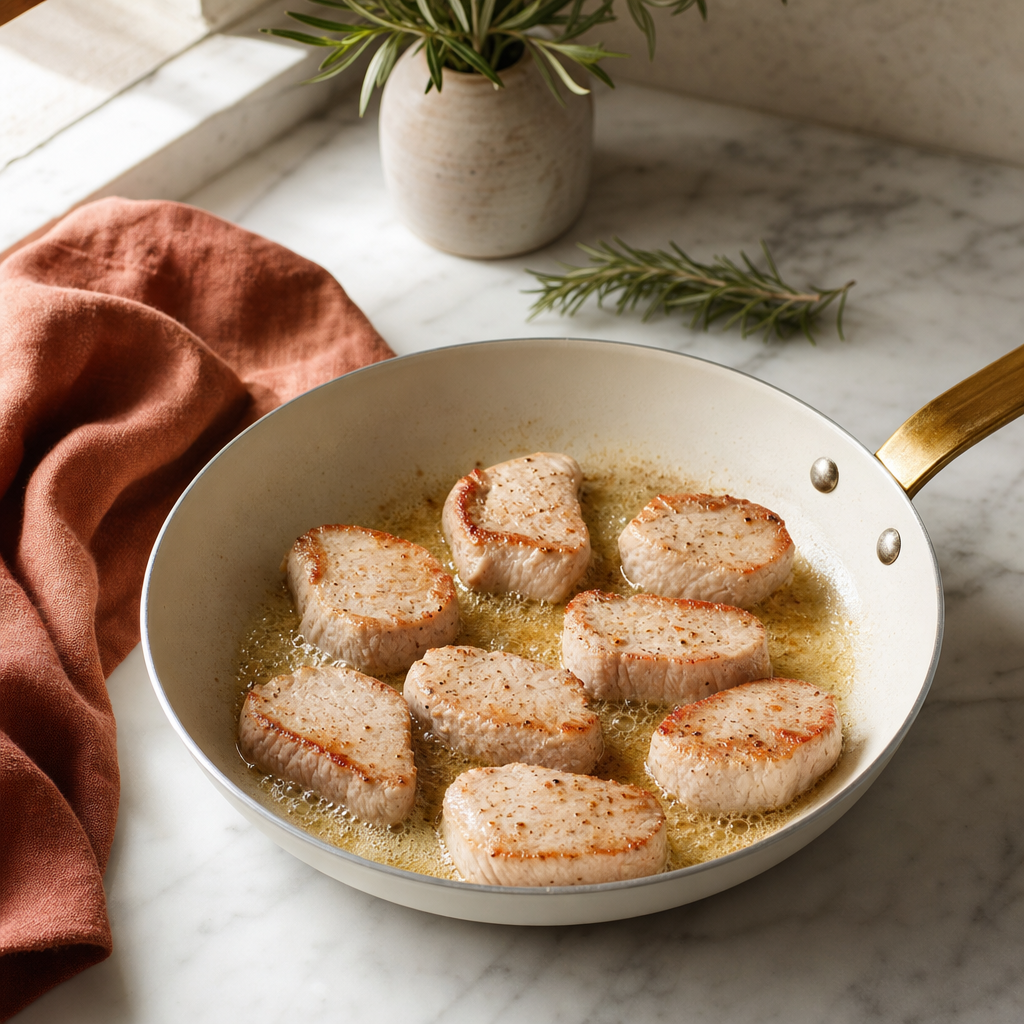
Melt the butter in a small pan over medium heat. Add the pork loin and cook until the pieces are opaque, lightly browned at the edges, and no longer raw in the center, 4-5 minutes. Cool completely.
Grind the filling fine
Grind the cooled pork, prosciutto, and mortadella through a fine plate, or pulse in a food processor until the mixture forms a dense paste with no visible chunks. Mix in Parmigiano-Reggiano, egg, nutmeg, and black pepper. Cover and refrigerate at least 2 hours, preferably overnight.
Make the egg pasta dough
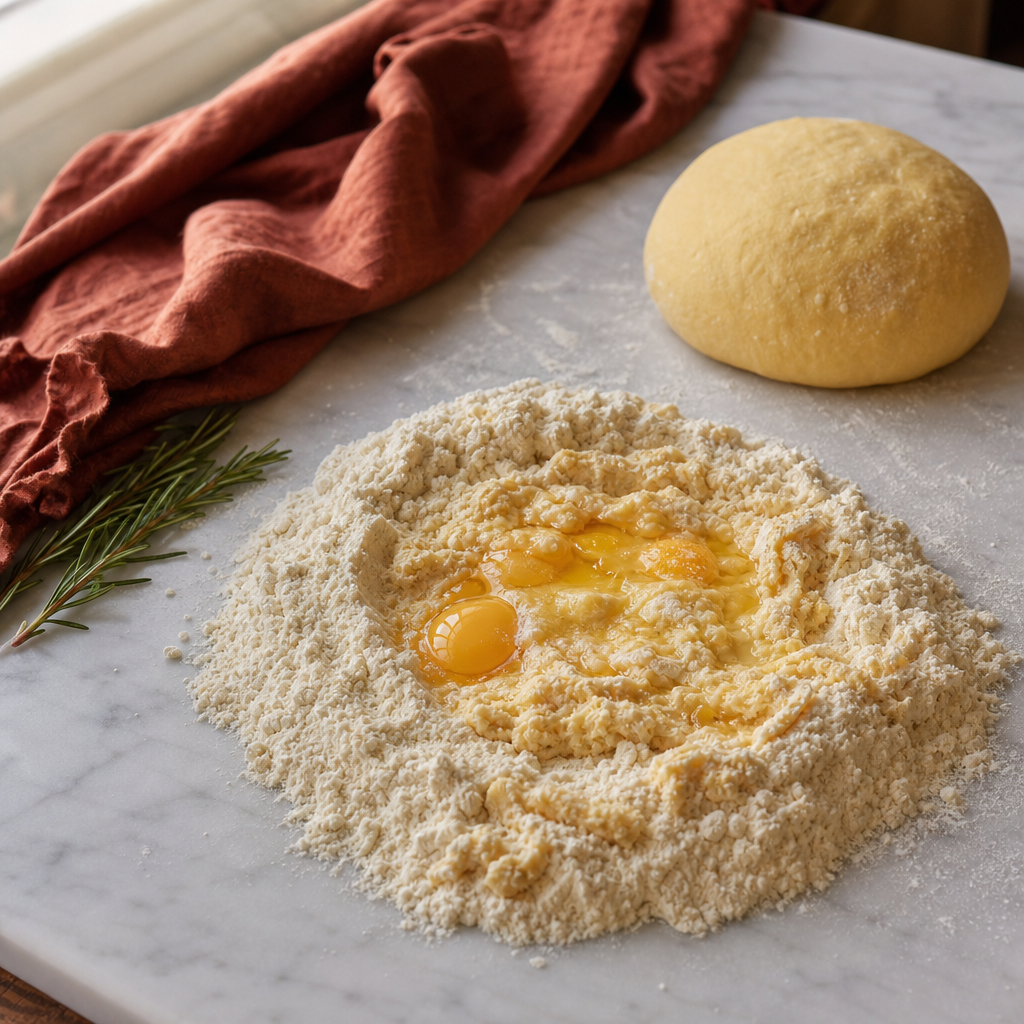
Mound the flour on a board, make a well, add the eggs, and work the flour in until a shaggy dough forms. Knead 8-10 minutes until smooth, firm, and slightly tacky but not sticky. Wrap tightly and rest 30 minutes at room temperature.
Roll thin sheets
Divide the dough into workable pieces and keep the rest wrapped. Roll one piece at a time to a thin sheet, about 0.6-0.8 mm, where a hand shadow is faintly visible through it. Dust sparingly; excess flour makes the broth cloudy.
Cut small squares
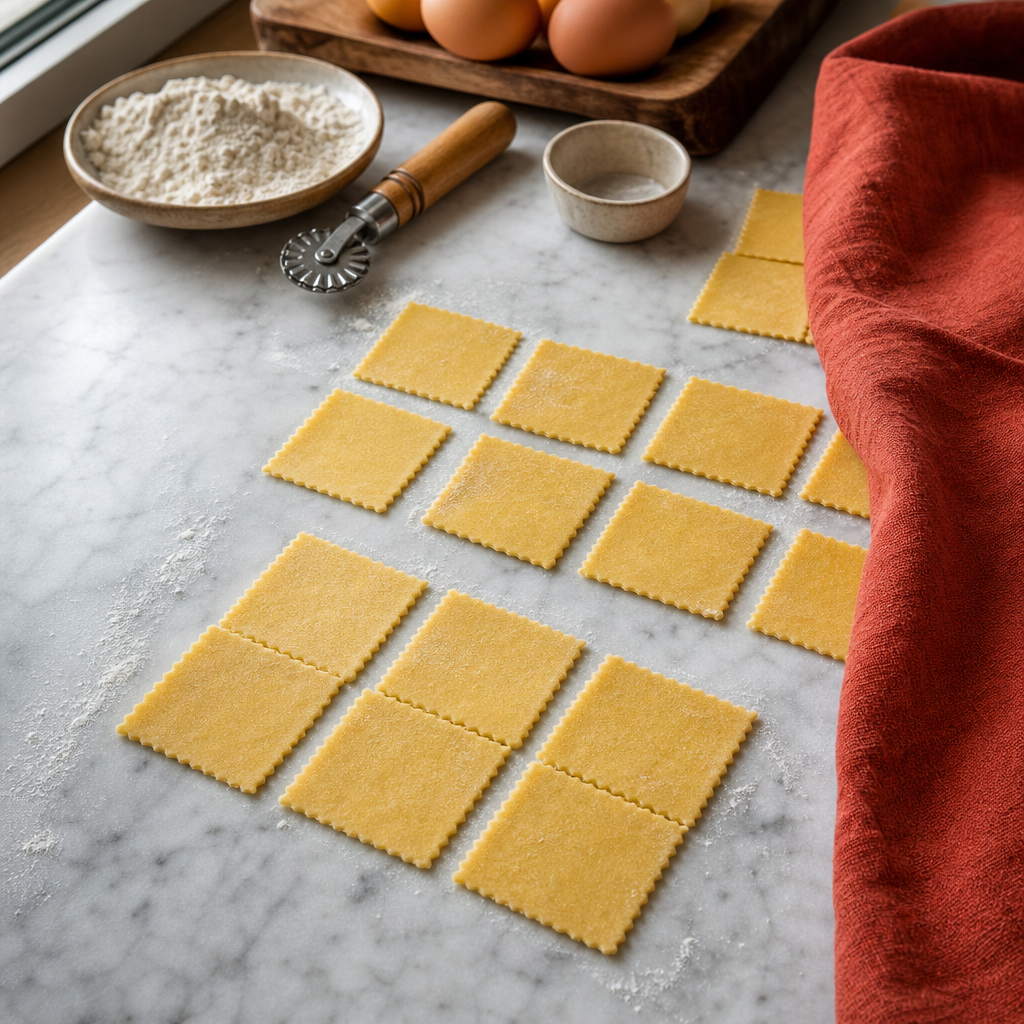
Cut the sheet into 3-3.5 cm squares. Work in small runs and cover unused squares with a towel if the room is dry. Do not let the edges leather over.
Fill and fold
Place a pea-sized amount of filling in the center of each square. Fold corner to corner into a triangle, press the edges closed without trapping air, then wrap the two long points around a fingertip and pinch them together. Set the tortellini on a lightly floured tray in a single layer.
Cook in broth
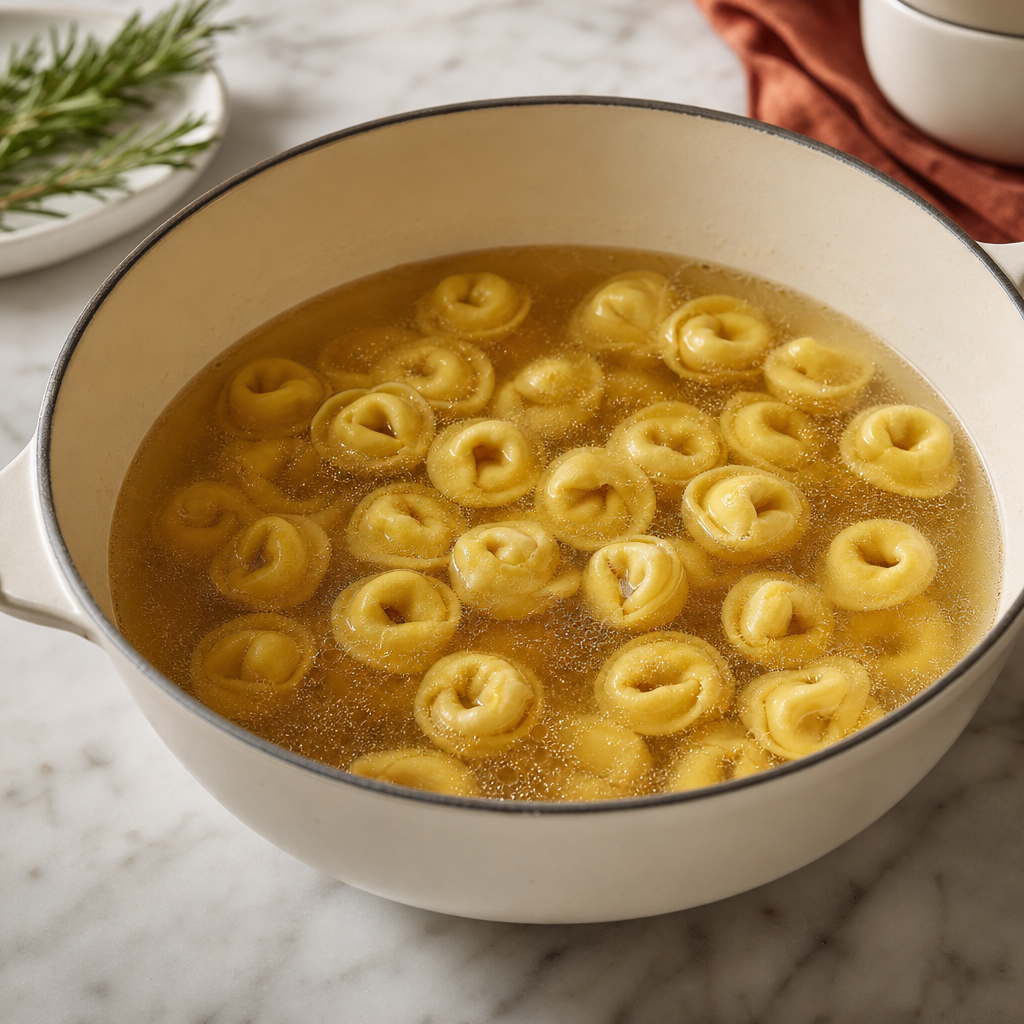
Bring the finished brodo to a steady simmer, not a rolling boil. Add the tortellini and cook 3-5 minutes, until they float and the pasta edge is tender with a slight bite. Serve immediately in the same broth.
Serve without clutter
Ladle broth and tortellini into warm shallow bowls. Add grated Parmigiano-Reggiano at the table only if wanted, in a small amount. The bowl should remain broth-forward, not cheese-thickened.
Common mistakes
- {'mistake': 'Using cheese tortellini.', 'fix': 'Use the meat filling. Ricotta or spinach tortellini belong to a different pasta tradition and change the dish completely.'}
- {'mistake': 'Boiling the broth hard.', 'fix': 'Hold a bare simmer. Hard boiling emulsifies fat and protein into the liquid, giving a cloudy, heavy broth.'}
- {'mistake': 'Rolling the pasta too thick.', 'fix': 'Roll to 0.6-0.8 mm. The finished tortellino should read as filled pasta, not a dumpling.'}
- {'mistake': 'Overfilling the squares.', 'fix': 'Use a pea-sized amount. Tiny tortellini need less filling than instinct suggests.'}
- {'mistake': 'Letting sheets dry before shaping.', 'fix': 'Cut and fold in small batches, keeping the remaining dough wrapped. Dry edges do not seal.'}
- {'mistake': 'Serving the vegetables from the stock in the bowl.', 'fix': 'Strain them out. Tortellini in brodo is spare: pasta and clear broth.'}
What does not belong
- {'item': 'Cream', 'reason': 'Cream does not belong in tortellini in brodo. The broth should be clear, not enriched into a sauce.'}
- {'item': 'Tomato sauce', 'reason': 'Tomato turns the dish into a pasta soup. The Bolognese structure is meat broth.'}
- {'item': 'Garlic and Italian herb mix', 'reason': 'Dried oregano, basil blends, and garlic flatten the cured-meat and nutmeg profile. They read as generic Italian-American seasoning, not Emilia-Romagna.'}
- {'item': 'Spinach, kale, peas, or soup vegetables in the bowl', 'reason': 'Vegetables in the finished bowl do not belong. The aromatics season the broth, then leave.'}
- {'item': 'Smoked ham or bacon in the filling', 'reason': 'Smoke is wrong here. Prosciutto crudo and mortadella give cured pork aroma without barbecue notes.'}
- {'item': 'Pre-grated shelf-stable Parmesan', 'reason': 'It is too dry, salty, and powdery. It makes the filling sandy and clouds the broth.'}